
NetZeroCities
EU NetZeroCities
Galway City participated in the EU NetZeroCities Pilot Cities Programme, testing innovative approaches to reducing carbon emissions. The pilot project focused on improving energy efficiency in buildings and aimed to address the barriers to retrofitting homes.
Key aspects of the project included:
- Community engagement: Galway Energy Co-operative led the establishment and operation of a community one-stop-shop, the Warm Home Hub, which provided information and guidance to households on their retrofitting journey.
- Ongoing support: Since the project concluded in Summer 2025, additional funding from the Department of Climate, Energy and the Environment, along with Galway City Council, has extended the initiative through at least December 2025.
- Research and training: The project also involved research into retrofitting skills and the delivery of training courses for contractors, alongside the development of strategies to address gaps in service provision and uptake.
- Governance: A multi-agency steering group was formed to tackle the challenges households face in retrofitting, at local, regional, and national levels.
- Knowledge exchange: Galway shared its experience with other European cities through twinning and learning arrangements. Galway was twinned with Belfast as part of this initiative.
The project officially began in June 2023.
Partners included Galway City Council, Atlantic Technological University (ATU) Galway, University of Galway, and the Northern and Western Regional Assembly.
for more information see article.

Warm Home Hub Extension
Galway Energy Co Operative received additional funding from the Department of Climate, Energy and the Environment and Galway City Council to extend our Community One Stop Shop work with the "Warm Home Hub" until December 2025.
Details of how to help you on your home energy retrofit journey can be found on the Warm Home Hub's Website pages on:
- Grant Options Page (explore partially and fully funded Grants here.
- To find out if you qualify for a free grant, grant checkers for two free grant types are available here.
- To check financial options for paying for a grant, information is available here.
- Landlord specific information is available here.
- You can also go to the Warm Home Hub's Resources and FAQ's menu including some instructional videos here.
SEAI Mentors for Galway City
Since September 2024, Galway Energy Co Operative has been Galway's SEAI SEC Mentor Organisation for Galway City.
This is Network currently of more than 1000 Communities Across Ireland.
If your Community would like to connect with a nearby Community find out more about setting up your own Sustainable Energy Communities, you can contact us.
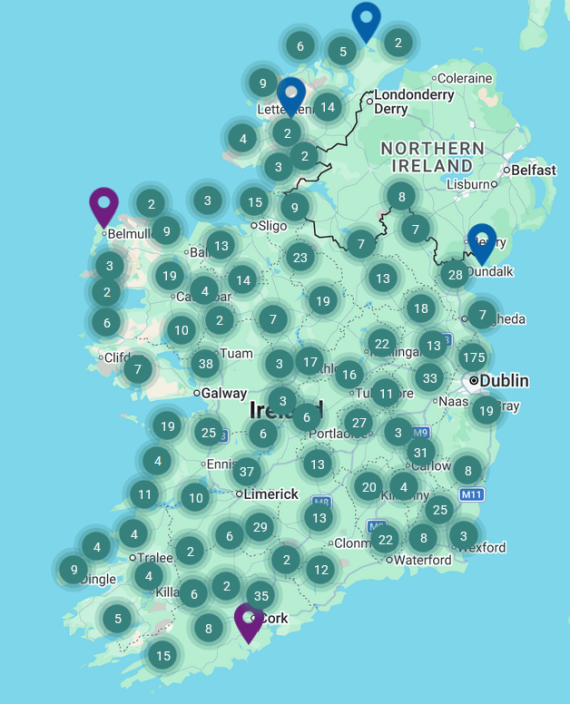
Sustainable Energy Communities (SEC)
As a participant in this Sustainable Energy Authority Ireland (SEAI) programme, we recently applied for funding for an Energy Master Plan for Galway.
The aim of this plan is to identify energy saving opportunities and promote community action, For a more detailed description of the plan, see seai.ie.
We have held a number of Community outreach events in Westside and Ballybane to recruit and encourage more communities to participate in our SEC or to set up their own.
Consultancy
We completed a comprehensive payback analysis for heating systems on behalf of a Housing Co-operative. The conclusions of this report, most of which are now implemented, include putting heat pumps into the housing estate. The project involved engaging with and educating stakeholders.
Collaborative Projects
STEPS - STorage of Energy & Power Systems in NWE
Galway Energy Cooperative is involved in STEPS - STorage of Energy & Power Systems in NWE. This is a Northwest Europe Interreg funded project which is very important for storage of renewables and for the future sustainability of Ireland, the UK and Europe.
HyBioSol
GEC is collaborating as Community Outreach Champion with a proposal put forward by NUIG experts, Dr Pau Farras and Dr Paolo Dessi. Their proposal, HyBioSol, involves converting CO2 containing effluents to biofuels (i.e., ethanol and/or butanol) and/or chemical commodities (i.e., acetic and butyric acid), or bioplastics.
This is part of the Science Foundation Ireland programme: Zero Emission Challenge.
Hydrogen
GEC has been instrumental in setting up a multi-stakeholder Hydrogen Team for the West Coast of Ireland.
Hydro
GEC has been instrumental in setting up a multi-stakeholder Hydro Power Team for Galway.
Ideas Exchange with German Cooperative
As part of a German Government programme, our cooperative is twinned with another cooperative in Pfaffenhofen in Bavaria.
While visiting the town on an ideas-sharing trip in September 2019, we observed a range of projects including a community-owned wind turbine, a biogas producing farm, a biomass fuelled eco-brewery, a large biomass facility, the local electricity and utility company, and historic electricity-producing water wheel. We also explored how the Pfaffenhofen cooperative grew to its current size.
We are looking forward to the return visit of the Pfaffenhofen cooperative to Galway in June 2020.